
Jackson County Previous Residents by Era
Previous residents research works best when the source matches the period. Jackson County deed books begin in 1827, but the early books and indexes are not one continuous online name search. A current parcel card supplies a legal description and a recorded-owner lead. From there, the Aumentum index, directories, plats, tax material, and archives each add a dated part of the trail. A street number alone is fragile because city labels, parcels, and numbering can change. Record the source date, the exact address form, the parcel, and the legal description before linking any two records.
| Source | Years it covers | Where held | What it can show |
|---|---|---|---|
| Recorder deed books and indexes | 1827 onward | Missouri State Archives and Recorder routes | Recorded parties, book and page, and land-description leads |
| Direct and indirect deed indexes | 1831-1885 | State Archives county guide and microfilm | Grantor or grantee paths into older deed books |
| Jackson County and Kansas City plat books | 1886-1925 | Missouri Digital Heritage and MGC holdings | Named landholders, tracts, subdivisions, and roads |
| Directory and telephone holdings | Selected years from 1859 onward | Midwest Genealogy Center and KCPL | A dated listed address, household clues, and adjacent entries |
| Aumentum real-estate index | Displayed permanent index from 1962 onward | Jackson County Recorder portal | Instrument parties, dates, types, book or page, and images where exposed |
Start with the newest official parcel information when the address is known. Move to the recorder for transfers, then step back to directory and archive material once the online index reaches its displayed limit. The State Archives guide is an inventory, not proof that every early volume is digitized. The same distinction matters for previous residents: a recorded owner is not automatically an occupant.
Jackson County Previous Resident Deeds
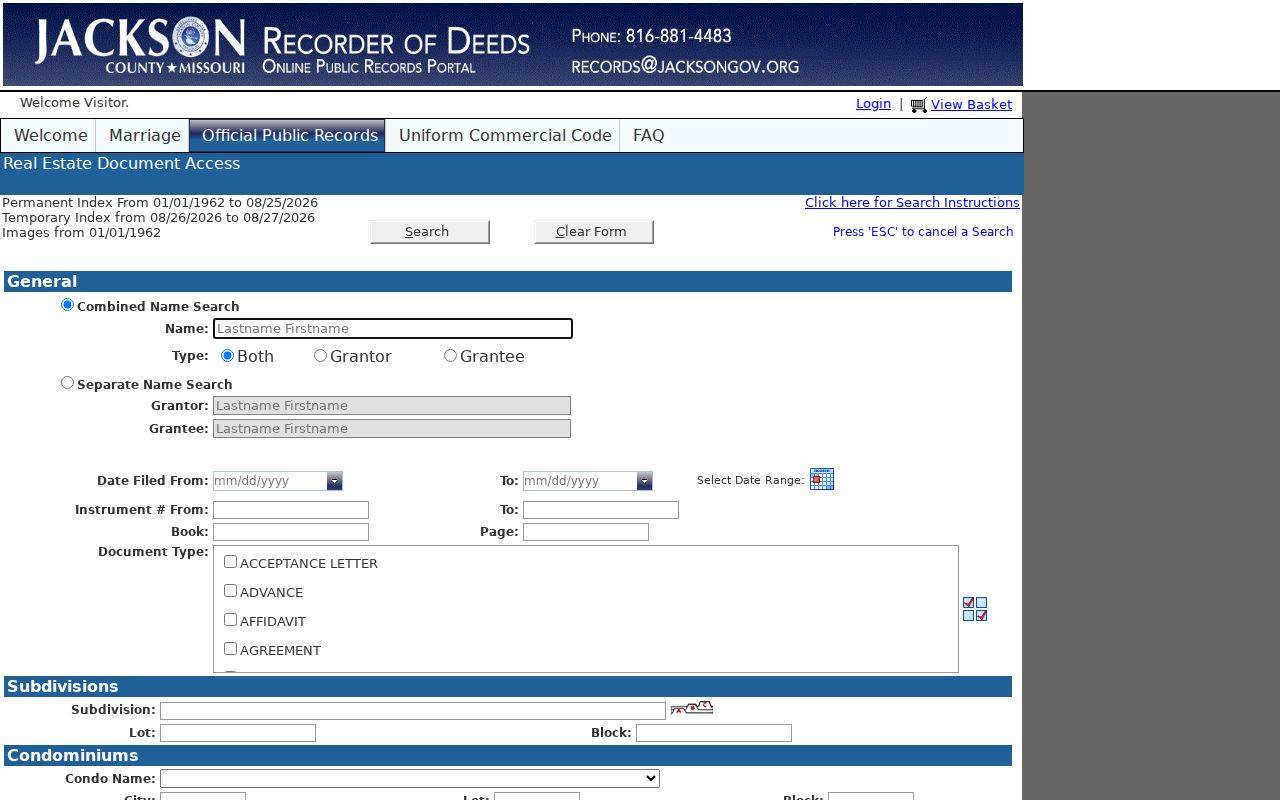
The Aumentum real-estate index is the practical online starting point for a modern Jackson County deed trail. It accepts a combined name or separate grantor and grantee fields. A property description helps narrow a broad name: use the parcel card's subdivision, lot, block, book, page, instrument number, or document type when those facts are already known. The recorded party may be a trust, estate, or organization, so preserve the name exactly as indexed before trying variants.
| Combined name | Search both parties, or select grantor or grantee when the role is known. |
|---|---|
| Date filed | Use a from and to range in month/day/year form to isolate a transfer. |
| Book or page | Use a recorded book and page once an earlier instrument supplies it. |
| Document type | The portal lists deeds, deeds of trust, releases, easements, plats, probate items, and other instruments. |
| Subdivision, lot, block | Use land-description clues to separate same-name parties or similar addresses. |
The Aumentum search screen displays the recorded-instrument controls used to begin an address-history search.
Use a result as a lead to the instrument and its legal description, not as a conclusion about who lived at the property. Note: Aumentum's displayed coverage and image availability can change, so save the portal date with each Jackson County previous-residents search.
Jackson County Past Residents and Deeds
A backward chain starts with the current property record, not a guess about a surname. The Jackson County Public Property Portal can supply the address, parcel identifier, owner and mailing address as shown, and legal-description clues. Those are assessment facts. The deed chain is built in the recorder index by reading each recorded transfer in order. A warranty deed, quitclaim deed, trustee deed, release, or plat can mean different things, so inspect the document type before treating it as a change of ownership.
- Find the parcel and legal description using the county property portal or parcel map.
- Search the current recorded party as a grantee in Aumentum and capture the instrument number, date, document type, and book or page.
- Read the seller on that instrument, then search that seller as a grantee to locate the prior acquisition.
- Repeat the sequence while comparing the legal description, subdivision, lot, and block instead of relying on the street number.
- When the online trail ends, use the State Archives guide, microfilm, and Recorder request route for the matching index or deed book.
- Grantor and grantee
- The grantor transfers or gives an interest. The grantee receives the interest named in that instrument.
- Chain of title
- A sequence of recorded instruments connected by the same parcel or legal description. It is not a guarantee of complete title status.
- Legal description
- The lot, block, subdivision, tract, or other land wording used in the record. It can stay useful when a street address changes.
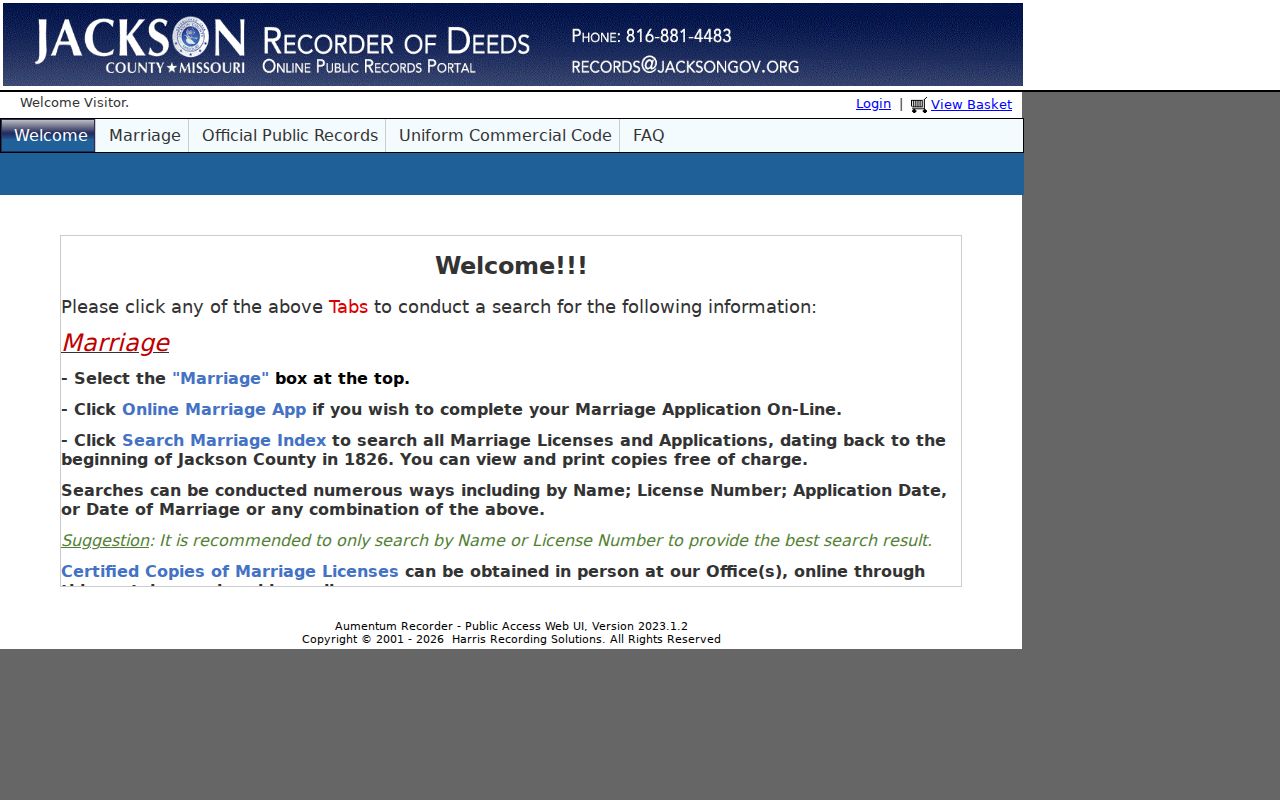
The Aumentum public-records home page is also a reminder that recorder material can have separate menus and date instructions.
Save the search terms and the record role at every step. That small log makes a Jackson County past-owner chain easier to review when a parcel split, name variant, or entity appears.
Jackson County Previous Residents Archives
Older Jackson County work shifts from a live index to a custody trail. The Recorder's official office is at the Historic Truman Courthouse, 112 W Lexington, Suite 30, Independence. Its listed telephone number is 816-881-4483, email is records@jacksongov.org, and hours are Monday through Friday from 8:00 a.m. to 5:00 p.m. The office says it does not conduct telephone searches. Call or email to route a request, then provide names, dates, instrument details, book or page, return address, and payment instructions when a copy is needed.
The Missouri State Archives county-record database can be searched by county, office type, record type, content keyword, city, and year range. For older deeds, its Jackson County guide identifies direct and indirect indexes, deed volumes, and microfilm context. The Archives also offers research and copy routes for people who cannot visit. The Recorder is the local authority for post-1970 county recorder records, while the older search may need a State Archives reel or a reading-room request.
Mail and in-person research remain useful when a book is not online. A written Sunshine request should identify existing records, dates, desired format, and a fee cap. Missouri's Sunshine Law, RSMo §610.023, calls for a response as soon as possible and no later than the end of the third business day, subject to lawful delay or denial.
Jackson County Past Residents House Clues
Land title and building history are different trails. The Kansas City Public Library's KC History collections point house researchers to city directories, maps, yearbooks, oral histories, and the 1940 Tax Assessment collection. A 1940 assessment image can offer a dated building or address clue. Match it to the parcel and legal description before treating it as the same property. The Library of Congress Sanborn collection can add building-footprint context for covered Kansas City years, but map coverage is specific to a city, year, catalog item, and sheet.
For a donated abstract, plat, photograph, or family file, the Jackson County Historical Society research route requires an appointment and a specific request to its archivist. Its holdings include maps, atlases, plats, deeds, wills, city directories on microfilm, clippings, and family papers, but no abstract is promised for every address. The Midwest Genealogy Center is the stronger first stop for catalog and microform questions. Its Jackson County collection spans 1894-2001, and staff can help arrange microform loans when a known volume is not online.
These repositories provide online catalogs, email or phone routing, appointment research, branch readers, and some loan or copy options. Each result should be labeled as a title record, a building clue, a listed address, or evidence of actual occupancy. Note: A historical map or assessment image can strengthen a house history, but it does not establish continuous residence.
Jackson County Previous Residents Household Trail
Previous residents become household research only when a dated directory, census schedule, obituary, newspaper, or comparable source supports that connection. The Midwest Genealogy Center says its catalog can locate print city directories and phone books, while some microfilm and microfiche titles need staff help. Its holdings guide lists Kansas City city-directory material from 1859 onward in selected formats and Independence runs across selected years. A directory entry is a time-stamped listing, not proof that someone stayed at an address before or after that edition.
- Choose the city label and directory year nearest to the deed or map date.
- Ask MGC for the exact title, publisher, roll or fiche, and whether both name and street sections exist.
- Read the entry and surrounding entries for address abbreviations, household markers, and street sequence.
- Pair that dated listing with the available census year, then compare names, address form, and relationships before treating it as the same household.
- Use the MGC obituary index, KCPL newspaper images, or probate material to test a move, death, or family link.
MGC's obituary index records leads such as name, birth or death date, newspaper citation, county, cemetery, and source information. It is not a complete obituary scan or proof of residence. The collections themselves are described in the Jackson County city directory material, where the directory holdings and entry conventions have their own context.
Jackson County Previous Resident Gaps
A gap is a research finding, not a reason to fill in a story. MGC's official material inspected for Jackson County did not identify a specific reverse-directory or criss-cross title, publisher, and run. Ask staff to search the catalog and uncataloged guides for a street section, Polk-style address section, telephone white-page street index, or alternate city label. Do not state that a reverse directory exists until the repository confirms the exact title and year.
Address changes create another gap. A deed's legal description may remain stable while the situs address changes. A mailing address can belong somewhere else, and a tax record can lag behind a transfer. Test former street spellings through city planning, public works, address-assignment records, plats, ordinances, historic maps, and newspapers for the municipality where the road lies. If there is no public index, request the dated ordinance or map from that municipal custodian.
Jackson County's 2025 Public Property Portal launch makes current assessment searching easier, but the card is still informational and changes as county data changes. Compare it with a recorded instrument and dated historical material rather than forcing a current field into a past-residents conclusion. Note: A failed address search may reflect a legacy number, parcel split, city-label difference, typo, or record series outside the portal's date span.
Jackson County Previous Residents Boundaries
House history is a lawful personal, family, and local-history activity. Keep a source, date, and record role with every conclusion. County assessment data may show an owner name or mailing address, but it does not prove present occupancy. A recorder index identifies a recorded instrument, not every agreement or a complete title opinion. Historical directories can omit people, use a business name, or list a former street number. A missing record can mean a gap, a restricted file, an unindexed series, or a different jurisdiction.
Missouri Safe at Home gives qualifying participants a substitute-address option under RSMo §§589.660-589.683. A protected address or missing result is a stop point. Do not attempt to reconstruct it through parcel, voter, directory, court, or nearby-address clues.
Lawful use. Jackson County previous-residents research belongs to house history, family history, estate questions, and personal curiosity. Do not use public records to track, harass, intimidate, or harm a living person.